How to Choose a Gear Reducer for a Slat Conveyor: Requirements, Slat Sizes and Materials
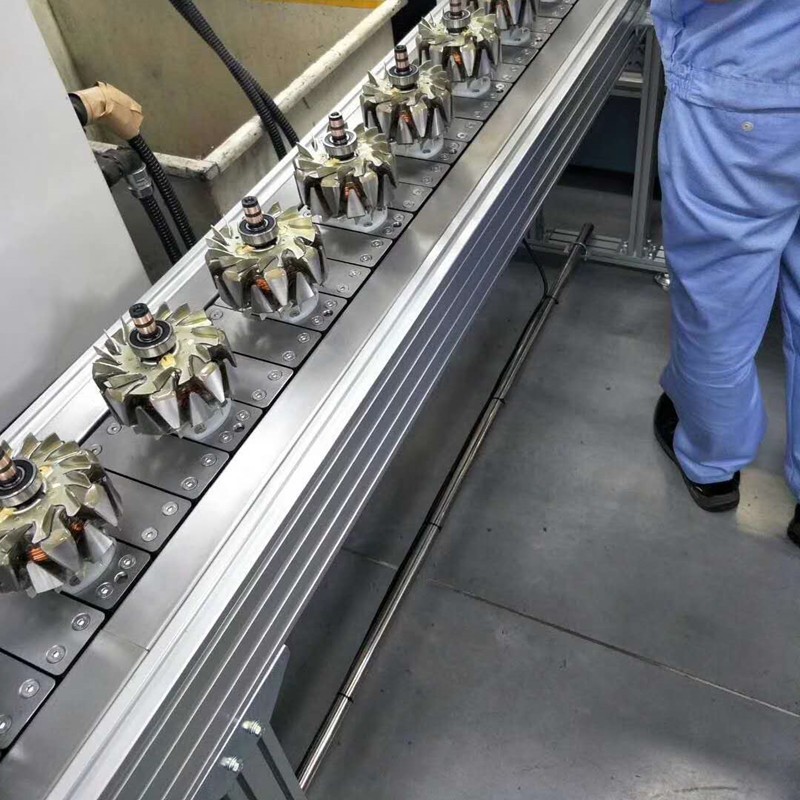
Quick answer: A chain plate (slat) conveyor is driven by a geared motor, and the reducer must meet four requirements: enough torque and power with margin, a ratio that delivers the target chain speed, a mounting style that fits the frame, and protection suited to the site (higher ingress protection for wash-down or wet areas). Inclined lines also need a backstop. Slat width and material are chosen by product and process.
How a slat conveyor works
A slat conveyor is a general-purpose fixed conveyor that carries products on standard slats and is driven by a geared motor. Its main parts are the motor, reducer, drive shaft, sprockets, chain, slats, take-up, bearings and frame. The circulating chain provides traction and the slats carry the load horizontally or on an incline.
It is widely used in automated manufacturing, pharmaceuticals, beverages, cosmetics, dairy, auto parts, power, metallurgy, brewing and chemicals.
4 requirements for the gear reducer
| Requirement | What it means |
|---|---|
| Torque and power | Calculate the torque needed for the total chain load (product + slat weight) and friction, then add margin for start/stop frequency and duty so it never runs hot at full load |
| Ratio | Work back from target chain speed: chain speed (m/min) ≈ output speed (rpm) × sprocket teeth × chain pitch (mm) ÷ 1000 |
| Mounting | The motor can sit below or above the frame; choose right-angle, parallel-shaft or hollow-shaft mounting to suit space and maintenance |
| Protection and housing | Use higher protection or stainless housings for food, beverage and wash-down areas; use a reducer with a backstop on inclined lines |
Example: with a 15-tooth sprocket, 38.1 mm chain pitch and a target of about 20 m/min, the reducer output speed is roughly 20 × 1000 ÷ (15 × 38.1) ≈ 35 rpm — choose the ratio from there.
Slat widths
| Type | Common widths (mm) |
|---|---|
| Straight-running slats | 63.5, 82.5, 101.6, 114.3, 152.4, 190.5, 254, 304.8 |
| Side-flex (curve) slats | 82.5, 114.3, 152.4, 190.5, 304.8 |
Slat materials and curve types
- Materials: POM (engineering plastic), stainless steel and ferritic stainless — chosen by product and process;
- Curve types: tabbed curves and magnetic curves, so one line can run straight and turn in the same plane — common for continuous glass-bottle conveying.
FAQ
Should the motor sit above or below the frame?
Either works. Below the frame saves side space and looks tidier; above makes maintenance easier. Choose by available space and maintenance practice.
Can the slat conveyor speed be adjusted?
Yes. A variable-frequency drive gives stepless speed control within a range; size the reducer so your normal speed sits in its efficient range.
Related equipment
- Chain Plate Conveyor — 200–1500 mm wide, stainless, carbon steel or POM
- Double-Speed Chain Conveyor — pallet-based assembly lines
- Want the reducer sized for your load? Contact our engineers.
Our engineers offer free selection and solution design